
My Leadership

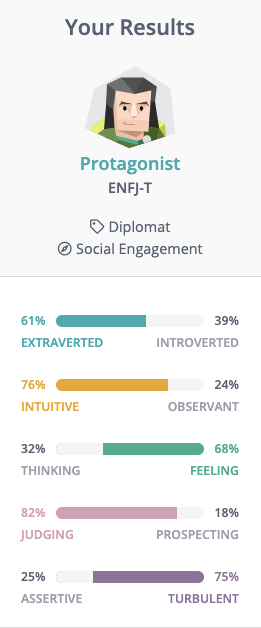
Myers-Briggs Type Indicator (MBTI) assessment reveals people’s personalities through four types of dichotomies in terms of Extraversion (E) – Introversion (I), Sensing (S) – Intuition (N), Thinking (T) – Feeling (F), and Judging (J) – Perceiving (P) (Lake et al. 2019: 93). My current leadership style is revealed by using this model in 16Personalities.com, which defined me as a Turbulent Protagonist with Extroversion, Intuition, Feeling, and Judging, and that signals the courage and strong motivations to inspire and guide people to improve themselves (Deida 2019). Therefore, it is believed that I’m a Transformational Leader that influence people’s attitudes and beliefs through a positive vision, along with some charismatic nature to inspire followers (Faupel, and Süß 2019: 146).
Leadership Style To Be Adopted
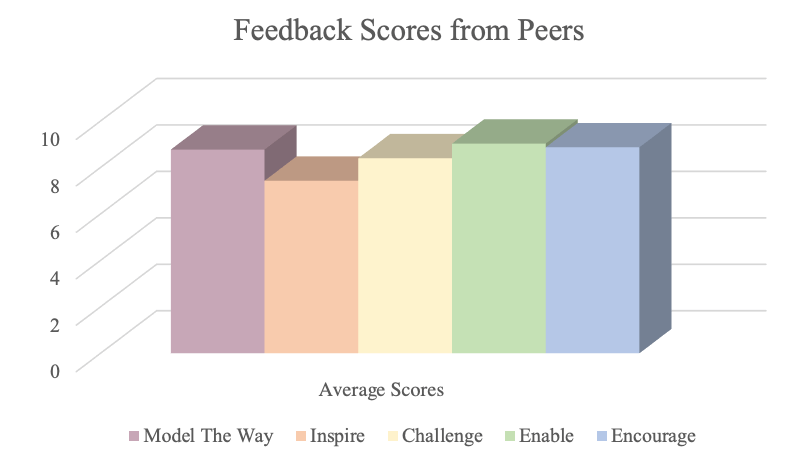
According to Peer Review Forms, I got the lowest average score of 7.43 over 10 in Inspiring people, which reflects the gap between my own perceived leadership and the perceived leadership by others. Thus, the leadership that should be adopted is Inspirational Leadership that motivate people through triggering followers’ confidence and initiating positive team ambience (Waldman, Balthazard, and Peterson 2011: 61). The feedbacks that I had acquired were surprisingly similar, which stated that I am too individualistic without social interaction, which is most probably the reason I failed to inspire people, because inspirations are transferred through certain channels and my anti-social behaviour is isolating my inspirations from followers (Ohunakin et al. 2019: 446). Therefore, I’ll spend more time with my followers to interact and provide appropriate inspirations to them after proper understanding about their different areas that require inspirations.
The highest average score is 9.03 in the category of Enable, which I had provided sufficient supports to enable my peers to achieve growth and capture opportunities. Hence, I am considered as an Empathetic Leader that provides emotional support and concern for followers’ wellbeing, which is my Blind window in Johari Window, and the it signals to me that I need to open up myself to understand more about myself from others’ perspectives (Ha 2019: 3; Kock et al. 2019: 218). Although in the feedbacks, the followers enjoy my leadership with clear guidance and good examples, but there are still a large space of improvement, such as the second lowest average score of 8.40 in terms of Challenging myself, and third lowest average score of 8.77 in Modelling the Way, which I’ll try to take on more responsibilities to challenge and increase my potential, and at the same time increase my interactions with followers to allow better demonstration of example as a role model.
Source of Inspiration
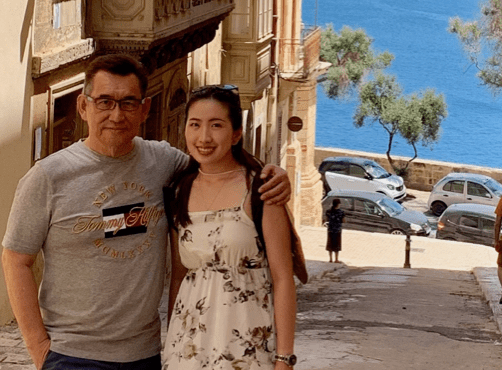
The inspiration in my process of becoming and being a leader is my father, who is a corporate trainer that provides training to corporate employees like salespeople and managers, and I had adopted some elements of his leadership in terms of leading the family and also leading the progress of his lectures. He is a Transactional Leader, who had been setting clear goals with rewards for his children including me, in terms of achieving academic results in school since we were just in primary school (Saeed, and Mughal 2019: 48). The rewards given posed as a motivation for me to work harder to achieve better results, thus the emphasis of motivation had inspired me to lead by motivating people to achieve beyond their potentials. Moreover, in his lectures that he held, his leadership style is Inspirational Leadership which communicates an attractive and achievable vision to energize the followers towards achieving the goals linked to the vision (Mitchell, and Boyle 2019: 270). Inspirational Leadership that he used to lead the lecture increase the liveliness of the lectures by fostering the students’ positive attitudes, which is why I truly believe that inspirations are crucial in engaging followers with their jobs and will increase the overall productivity and effectiveness of the team (Vallina, Simone, and Guerrero 2018: 1).
Readiness to Lead Others
After watching Simon Sinek’s (2009) video on TED, I realized that my leadership style has rooms for improvements, which I require more time to adopt the inspiring skills in my MBA courses to increase my readiness to lead people more effectively. Sinek had emphasized a Golden Circle with the shape of a dartboard, and he explained the idea of inspiring people from the bullseye of ‘Why’ to the outer circle of ‘How’, and then to the most external circle of ‘What’, because the process of inspiring people requires the communication of the leader’s belief or vision that engage with followers’ hearts and souls (Sinek 2009). However, my leadership which focuses on ‘What’ and ‘How’ only communicate what and how I can contribute to my followers, they only engage with people’s Neocortex Brain that process rational information, instead of Limbic Brain that deals with feelings like trust and loyalty (Sinek 2009). Hence, the different arrangement of the information conveyed to followers will increase my readiness to lead because followers will be more willing to accept my leadership when they agree with my beliefs (Sinek 2009).
(752 words)
References
Deida, D. (2019) Protagonist Personality [online] available from <https://www.16personalities.com/enfj-personality> [2 November 2019]
Faupel, S., and Süß, S. (2019) ‘The effect of transformational leadership on employees during organizational change—An empirical analysis’. Journal of Change Management [online] 19(3), 145–166. DOI: 10.1080/14697017.2018.1447006 [3 November 2019]
Ha, K. M. (2019) ‘Integrating the resources of Korean disaster management research via the Johari window’. Evaluation and Program Planning [online] 77, 1-6. DOI: 10.1016/j.evalprogplan.2019.101724 [10 November 2019]
Kock, N., Mayfield, M., Mayfield, J., Sexton, S., & De La Garza, L. M. (2019) ‘Empathetic Leadership: How Leader Emotional Support and Understanding Influences Follower Performance’. Journal Of Leadership & Organizational Studies [online] 26(2), 217–236. DOI: 10.1177/1548051818806290 [10 November 2019]
Lake, C. J., Carlson, J., Rose, A., and Thiele, C. C. (2019) ‘Trust in name brand assessments: The case of the Myers-Briggs Type Indicator’. The Psychologist-Manager Journal [online], 22(2), 91–107. DOI: 10.1037/mgr0000086 [2 November 2019]
Mitchell, R., and Boyle, B. (2019) ‘Inspirational leadership, positive mood, and team innovation: A moderated mediation investigation into the pivotal role of professional salience’. Human Resource Management [online] 58(3), 269–283. DOI: 10.1002/hrm.21951 [3 November 2019]
Ohunakin, F., Adeniji, A. A., Oludayo, O. A., Osibanjo, A. O., and Oduyoye, O. O. (2019) ‘Employees’ retention in Nigeria’s hospitality industry: The role of transformational leadership style and job satisfaction’. Journal of Human Resources in Hospitality & Tourism [online] 18(4), 441-470. DOI: 10.1080/15332845.2019.1626795 [10 November 2019]
Saeed, M., and Mughal, Y. H. (2019) ‘Role of Transactional Leadership Style upon Performance: Mediating Role of Culture’. Journal of Managerial Sciences [online] 13(1), 47–57. available from
<https://search-ebscohost-com.ezproxy.uow.edu.au/login.aspx?direct=true&db=bth&AN= 138289352&site=eds-live> [3 November 2019]
Sinek, S. (2009) How Great Leaders Inspire Actions? [online] available from <https://www.ted.com/talks/simon_sinek_how_great_leaders_inspire_action?nolanguage=en+Leadership+qualities%2Factions#t-1065422> [5 November 2019]
Vallina, A. S., Simone, C., and Guerrero, R. F. (2018) ‘The human side of leadership: Inspirational leadership effects on follower characteristics and happiness at work (HAW)’. Journal of Business Research [online] 1-10. DOI: 10.1016/j.jbusres.2018.10.044 [3 November 2019]
Waldman, D. A., Balthazard, P. A., and Peterson, S. J. (2011) ‘Leadership and Neuroscience: Can We Revolutionize the Way That Inspirational Leaders Are Identified and Developed?’ Academy of Management Perspectives [online] 25(1), 60–74. DOI: 10.5465/AMP.2011.59198450 [10 November 2019]
 MBA
MBA 
Hello Mel! Very good analysis of yourself. You’ll be a great leader in the future! 🙂
I wanted to know your view on, how does one earn their leadership skills?
LikeLike
Good day Meya! I think leadership is earned through one’s own mindsets, which the correct mindsets will increase the probability of leading the right way.
I think it is utterly important to have the intention to understand the followers’ thoughts, which the mindset to know what others need will be helpful to allow the leader to lead better in terms of bringing the followers towards a right direction. Plus, the mindset of understanding others will gain respects from followers, which I also believe that it is a crucial part to allow followers to accept the guidance from the leader.
Moreover, I think leadership skills can be increased through enhancement of own knowledge and expertise, because a leader in a specific industry or area requires certain amount of knowledge, so that the followers trust the leader’s direction and follow the leader.
In the end, I think a leader without follower is just an ordinary person, which the gaining of leadership skills is simultaneously gaining followers, or vice versa, hence the prioritization of followers’ psychological needs must be understood before aspiring to earn leadership skills instantly.
LikeLike
Wow Melissa, such a good analysis on yourself! Also, it’s interesting to know that your father is the one who inspired you. I’m just curious, if you ever face problems or issues working in a team? If you do, how do you overcome it? Did you ask advices from your dad?
LikeLike
Good day Pei Kie! Of course I had faced issues when I was working in a team, as it is unavoidable to work in a team throughout my Degree and Master. There was an issue that I met back in my degree which I most remember, I had differing opinions with my teammates and we were intensely arguing against each other to persuade each other to follow own opinions. Thus, the disagreements caused us to work on our own work without any consideration of each other’s work, which had led both parties to fail in achieving the course requirements. It was a great experience to know that I shouldn’t be so selfish in making decisions, because working in a team requires consideration of all members instead of just myself. Hence, the next time I joined a team, I started to learn to listen to people’s opinions even when I don’t agree with it, because understanding their views are equally important as my views, and understanding the opinions is increasing the probability of success in the team because merely one source of view from myself is definitely insufficient to succeed in multiple areas. I did not ask advices from my father every time I meet difficulties, but I did remember his advice long time ago, which is “Life is not a life without adaptation and learning”, which had kept me going further and further to learn with open-mindedness.
LikeLiked by 1 person
Great reflection of yourself, Melissa. It’s very impressive that you look up to your father. In your conclusion, you mentioned your leadership focused on Sinek’s “what” and “how.” How do you see yourself starting with Sinek’s “why,” where you inspire people straight at the core?
LikeLike
Good day Kiki! That’s an interesting question, which I had not thought of it in dept before.
I always have a personal motto that I keep in my mind all the time. It is “When you start doing it, it will go according to your wish”, which have several meanings and it can be used in many situations. Firstly, it means that I need to start doing something instead of just ranting or complaining, because if I don’t even do it, the progress stays at 0% all the time, and I will never achieve anything. For example, when there are all four assignments that are due soon in the Master course, I would push myself to start doing it no matter how hard it sounds or how slow I will progress, because things only get easier when I start doing it and get to know more about the assignments. Secondly, when I want people to do something for me, I have to start doing the same thing first, or else it is unreasonable to ask people to do things that I don’t even do. For example, I am a big fan of living a life that brings the least damages or harms to the environment, thus I start to reduce the usage of plastic products such as bringing own container or tumbler when I take out food and beverages, because I believe that good things like environmental conservation will only be practiced by everyone on Earth when I start with myself, and everyone else also have the same thought.
Therefore, my “why” is the belief of “Starting with Myself”, and I believe that this mindset will make the world a better place, as it is also reducing behaviours of laziness and shirking my own responsibilities.
LikeLike
Hi there Melissa! Your blog gives great reflection on who you are as a leader and you always support it with a theory behind it! Good Job! So, given by your vision of leadership, as a leader, what type of employees do you think would work best with you?
LikeLike
Good day Khoi! Thanks for the compliment, I really appreciate that!
If I were a leader, I think the employees that are straightforward to me will work best, because I believe that I’m a person that can easily get complacent due to small achievements, hence I hope that my future employees or followers can be honest and straightforward in providing feedback to my leadership style and behaviours. Moreover, I think people who love adventures will work really well with me, because I don’t like boring jobs or dull tasks, which is why I would always do something different in my job to experience different things. For example, when I clean up my room at home, I would listen to upbeat music and throw durable items across the room like playing basketball. Therefore, if the employees are willing take on adventures with me, I believe that it will make a really great team that always try to do things differently of more effectively, due to the encouragement of strange ideas.
However, I will not make a wish of getting the types of employees that I had stated above, instead I would like to take the challenge of getting a wide diversity of employees, so that I can learn different things from different people. Furthermore, the diversity is crucial for me to see different perspectives and help me in making better decisions.
LikeLike
Hello Melissa! Love how you interpreted feedback and explained on how it affects your leadership traits. You seem like a person that has experience in leading a team. Was your leadership style in your recent/current leadership experience the same as Transformational leadership?
LikeLike
Good day Shawn! I would say that my current leadership style is different from Transformational Leadership, because I think I do not provide a very clear vision like a real Transformational Leader do, for example, I give my followers autonomies to achieve a vision that is not specifically stated. This is because I believe in unintended consequences which may be end up better than the intended consequences, which is why I do not give a clear vision to be followed by the followers step-by-step. However, in terms of motivation provided to followers, I can be considered as a Transformational Leader, as I ensure that the followers are sufficiently motivated to have the energy and drive to perform their tasks. For example, I would ask my followers about their progress on their tasks, then if they seem to be upset about the workload, I would talk about what they had achieved before to let them know their worth and their strong capabilities, so that they know what they are capable of, and can be motivated to maintain their effectiveness and efficiency.
LikeLike